Tuesday, April 25, 2017

Silence (Dir. Martin Scorsese, 2016)

(Reviewed 4/5 on letterboxd in April 2017)

Scorsese in his own words called this film as hoping to open up a dialogue about faith beyond the realms of organized religion and to show that doubt is very much a part of faith. This is an extremely rich film with beautifully portrayed characters; especially on the Japanese side, considering the nature of the story.  The last scene which has been subjected to a lot of discussion in previous reviews felt like a "Rosebud" kind of moment in it's enigma. I will definitely need a re-watch to appreciate all it's ideas however it was very helpful to listen to Scorsese share his intent behind making the film right after the screening at MOMI.

Sunday, April 16, 2017

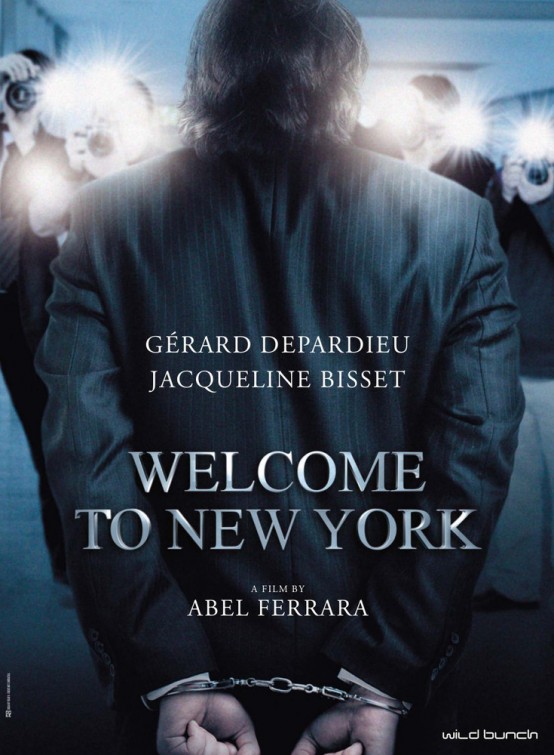
Welcome to New York (Dir. Abel Ferrara, 2014)


(Reviewed 4/5 on letterboxd in April 2017)

Feels even more relevant after the U.S. election. A sleazy billionaire in a position of power knows he can get away with pretty much anything. Ferrara makes the audience complicit (Pasolini style) by titillating it with the debauchery and later having the protagonist confess to his daughter that neither could she have made him stop nor did he have any intention to stop; then he looks into the camera and tells people to fuck themselves and ironically this does not come as a shock to us. "The irony is that no one wants to be saved", declares Depardieu's character to his psychiatrist, and you cannot help but agree with him.

Saturday, April 15, 2017

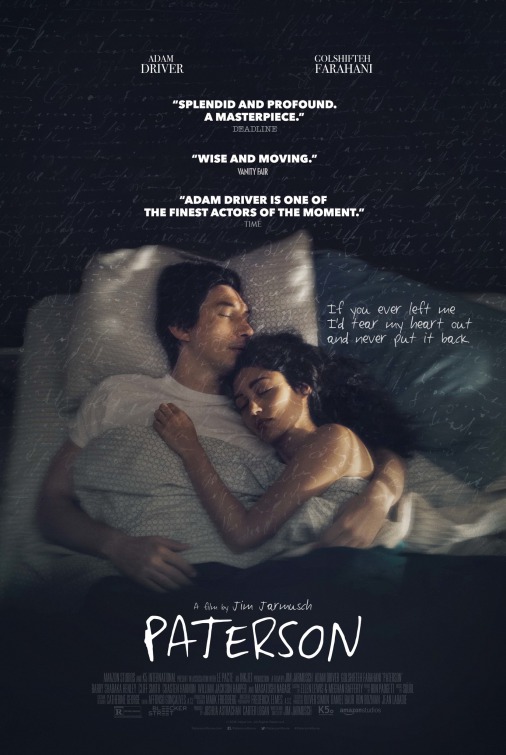
Paterson (Dir. Jim Jarmusch, 2016)


(Reviewed 4.5/5 on letterboxd in April 2017)

People usually don't like films about genuinely nice people; I seem to prefer them. Paterson is one of those nice guys who also happens to be a poet. While his colleagues and friends keep complaining about their lives, Paterson can't ask for more. He has a beautiful girl friend who he says "understands him very well". He has his secret notebook in which he writes words that come to his mind. He prefers not to call himself a poet; he is only a bus driver. For his girlfriend though, he is a poet and she keeps entreating him to make copies of his poems lest they get lost. Paterson also shuns technology and refuses to even carry a smartphone. Jarmusch finds great possibility in this basic premise and through his character's keen eyes and ears, finds poetry in the most unlikely places of a mundane New Jersey town with no personality. Therefore there is poetry to be found in laundromats, curtains, bedrooms, bars, streets, matchboxes, water falls, buses and even in the blank pages of a notebook. As one of his character reveals late in the film - "blank pages reveal endless possibilities" and Jarmusch surely knows how to use them.

Monday, March 27, 2017

Miss and the Doctors (Dir. Axelle Ropert, 2013)


(Reviewed 4.5/5 on letterboxd in March 2017)


One of those heartwarming films that make you wish you could inhabit some of the places on screen or could have simply known some of the characters ala a Yasujiro Ozu film.

Sunday, February 12, 2017

The Quince Tree Sun (Dir. Victor Erice, 1992)

(Reviewed 4.5/5 on letterboxd in February 2017)


"I too work with intensity. Time is precious. I work non stop now" - Enrique, the painter.

Erice reflects on the vanity of much of human endeavor, especially that of the artistic nature. In this film, the masons and the artist begin their work around the same time. While the masons will finish their task and leave, the artist's painting never gets finished. Somehow this film reminds me of an oft quoted philosophy from the Bhagvad Geeta: "To work is in our hands, attaining the fruits of labor is not". That's pretty much what most characters in this film do, continue to work as they race against their own mortality. Even so, there will always be another spring and new fruits for humanity to attain.

The Last of the Fast Guns (Dir. George Sherman, 1958)

(Reviewed 4.5/5 on letterboxd in Jan 2017)


Another gem discovered thanks to the letterboxd community. This was my first Sherman so came to this without any expectation. As others have remarked, I was impressed by the austere screenplay, great cinematography (the Mexican milieu is very convincing) and sparse but effective dialogues. The highlight of this film is definitely the great homo-erotic chemistry or male bonding between Bradley and Miles. Definitely a film I would like to re-watch in the future.

Sunday, December 25, 2016

Dangal (Dir. Nitesh Tiwari, 2016)


(Reviewed 4/5 on letterboxd in Dec 2016)

Bollywood has clearly found a liking for sport biopics. Ever since Chak De India (2007), there have been a spate of films on this theme. I haven't watched all of them but I will not be surprised if Dangal is perhaps the only worthy successor to Chak De.

Now, Bollywood loves melodrama and jingoism, so much so that it will turn to these emotions even if not intended at the beginning. SRK's Kabir Khan, who at the beginning of Chak De is shown driven to take revenge against the ignominy suffered during his playing days, finally gets his ambition reduced to ultra-patriotism. Similarly in Dangal, we have Aamir's Mahavir Phogat determined to have his daughters fulfill his ambition of winning a gold medal, not as a personal ambition but for the country. He even tries to explain the importance of winning gold to his daughter on the eve of the final of the Commonwealth games, explaining the influence she would have on the condition of women in India. He says this after making the more important point of striving for the best and not settling for the second best as is often observed in Indian sports. The prior dialogue is an unrealistic moment in the screenplay, typically introduced in Bollywood films to give a social message. It is a peculiarity of Bollywood films that I have learnt to ignore over the years.

What is it then that works in this fim; first of all the depiction of the trials and tribulations of the Phogat girls, fighting all patriarchal prejudices and inculcating extreme self-discipline as they develop into national level wrestlers. This was an aspect that we did not get to see in detail in Chak De.

The fight against the personal demons of the principal characters is perhaps better delineated in Chak De compared to Dangal. SRK's Kabir Khan is clearly better fleshed out compared to Aamir's Phogat who relies more on his physical transformation than his acting prowess. The other principal characters, especially the girls, are competent enough in their portrayals and evoke strong reactions through their performances.
The wrestling sequences are well shot, making the sport of women's wrestling appear as tough as it actually is. The fight scene between the wrestler father and daughter is devastating to say the least. The scenes often give you a real time ringside view of the action, making your back twitch with anticipation.

The film to a great extent remains understated and focussed. The moments of comic relief are typical Bollywood but do not distract significantly from the plot. The songs are again similar; apart from the wedding song, none feels totally unnecessary to the narrative. The title track has this "Omkara" vibe to it which, to music director Pritam's credit, is a good song and works well for this movie. Case in comparison, it's way better than the annoyingly jingoistic Chak De India track.

Finally, Dangal like Chak De India has a strong connect to the audience due to the real life significance that these stories had on women's sport in India. I expect this film, like Chak De India, to be a landmark film for Bollywood.