Saturday, June 11, 2016

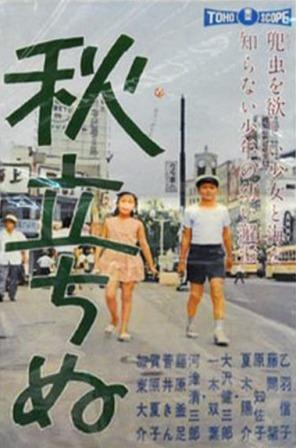
Autumn Has Already Started (Dir. Mikio Naruse, 1960)


(Reviewed 5/5 in December 2014 on letterboxd.com)

This film from Naruse appears to be a low budget personal venture that doesn't employ too many big stars as he was generally doing in this period of filmmaking. A fantastic portrait of alienation among children with unstable families who try to find comfort outdoors in the polluted urban landscape and in each others company. Perhaps a film as significant as the Antonioni from the same year but much less talked about for some reason.

Utamaro and His Five Women ( Dir. Kenji Mizoguchi, 1946)


(Reviewed 5/5 in December 2014 on letterboxd.com)

For once, while watching a Mizoguchi, I wasn't thinking about that glorified long shot aesthetic or mise-en-scene. Perhaps Mizoguchi's finest film featuring naturalistic acting, a strange tragicomic plot and the perverse madness behind an artists pursuit of capturing the soul of his subjects. An unexpected masterpiece.

Comanche Station (Dir. Budd Boetticher, 1960)


(Reviewed 5/5 in December 2014 on letterboxd.com)

"It's shameful what a man can do for money, eh Cody?...It's shameful." - Ben Lane

I don't remember the last time I watched a film that made such superlative use of cinemascope and at the same time told me so much about its characters with just a few dialogues. An austere masterpiece, just the way I like them.

Haider (Dir. Vishal Bharadwaj, 2014)


(Reviewed 4/5 in October 2014 on letterboxd.com)

I was encouraged to watch this film today after reading about the controversy surrounding it's supposedly anti-India and pro-separatist viewpoint but after watching it, found the controversy to be nothing but a storm in a tea cup as usual. (SPOILER BEGIN) By denying Haider's father his revenge, Bharadwaj clearly makes his position clear within the context of this film (SPOILER END). As far as Bharadwaj's attempt to adapt Hamlet,  I thought there were some great points: firstly Bharadwaj gives the character of Gertrude (Gazala in this film) more scope and very skillfully explores it's complexity. Tabu does a brilliant job essaying this character. Also the Oedipus complex aspect is more pronounced in this film than one finds by reading the play itself. There are some humorous bits like the Salman Khan fans as the clowns and even the small scene with the gravediggers which I thought was well done. Now coming to the less satisfying parts, I feel Bharadwaj muddles his film by trying to bring in a morality viewpoint to Haider's (Hamlet's) quest for revenge. He takes it to a point in the climax where "To be or not to be" doesn't even remain a question for Haider which I found a little difficult to digest as a Hamlet admirer but at the same time feels significant within the context of the film to emphasize Bharadwaj's pro-peace message to the audience. How successful he was in doing it remains debatable. I also found the insertion of the romantic song sequence completely unnecessary and it unfortunately took away the intensity that was being built up. The final title about the number of Kashmiri's who have died/disappeared (I forget which) felt irrelevant but was perhaps inserted to keep the Kashmir angle which I felt should have simply stayed as the backdrop, which to be fair it does for the most part.  I think overall it is still a pretty darn good film and might just grow on me further in some time.

The Age of the Medici (Dir. Roberto Rossellini, 1973)


(Reviewed 5/5 in September 2014 on letterboxd.com)

This was truly a unique experience. I haven't been a big Rossellini fan but this film was fantastic. I could see traces of Straub-Huillet in the presentation style but overall very little in common to anything I have seen before. 
To evoke the pulse and rhythm of a civilization through conversations of people of various strata of the society was a great idea. I wonder if Rossellini was inspired by the teachings of Leon Batista Alberti who occupies a significant role in the third part of the series. I will need more time to process this film and all its ideas.

Fandry (Dir. Nagraj Manjule, 2013)


(Reviewed 4.5/5 in September 2014 on letterboxd.com)

Jambuvantha alias Jabya, the son of a low caste villager has dreams of wooing a school mate who belongs to a high caste but cannot escape the incessant insults heaped upon him from the upper castes. His father is responsible to keep the wild pigs away from the village, a task which Jabya finds embarrassing due to the ridicule he receives from his classmates. In the end the embarrassment turns into seething rage which not only makes his chances of wooing the girl an impossibility but quite surely even to survive in that community. A sensitive film from director Nagraj Manjule portraying the ills of the caste system in the hinterlands of Maharashtra. I will be looking forward to watching more from him.

Thursday, November 12, 2015

A Blissful Moment

Sitting at the corner of an empty dining table;
In a room unfamiliar.
I look at the morning light from the entrance;
Flanked with silhouettes of familiar people.

A calmness has descended over the gathering;
That primitive satisfaction of full bellies.
Bodies huddled together;
Rejoicing quietly in this collective pleasure.

I feel like capturing this moment of bliss,
But have nothing except my senses.
To drink in this experience then,
Feels like the only recourse.

Conversations with relatives, old and young,
Revisit in this moment of solitude.
Some fragments of theology and philosophy;
Some anxious enquiries on matrimony

Some optimistic career and educational moves;
Some opinions on political subterfuge;
Some sad discussions about old age homes;
Some precious nuggets of wrinkled wisdom.

A sadness clouds my train of thoughts.
"Will there ever be another?";
That dreaded question.
That omnipresent fear of our transient nature.

But then I hear a familiar voice,
Waking me up from my reverie.
"Will you play with us?", it says.
"Will you come and join us?"

"Of course, I will", I said.
Springing up from that dining table chair,
I walk towards that bright light,
To be one amongst those silhouettes.