Sunday, December 25, 2016

Dangal (Dir. Nitesh Tiwari, 2016)


(Reviewed 4/5 on letterboxd in Dec 2016)

Bollywood has clearly found a liking for sport biopics. Ever since Chak De India (2007), there have been a spate of films on this theme. I haven't watched all of them but I will not be surprised if Dangal is perhaps the only worthy successor to Chak De.

Now, Bollywood loves melodrama and jingoism, so much so that it will turn to these emotions even if not intended at the beginning. SRK's Kabir Khan, who at the beginning of Chak De is shown driven to take revenge against the ignominy suffered during his playing days, finally gets his ambition reduced to ultra-patriotism. Similarly in Dangal, we have Aamir's Mahavir Phogat determined to have his daughters fulfill his ambition of winning a gold medal, not as a personal ambition but for the country. He even tries to explain the importance of winning gold to his daughter on the eve of the final of the Commonwealth games, explaining the influence she would have on the condition of women in India. He says this after making the more important point of striving for the best and not settling for the second best as is often observed in Indian sports. The prior dialogue is an unrealistic moment in the screenplay, typically introduced in Bollywood films to give a social message. It is a peculiarity of Bollywood films that I have learnt to ignore over the years.

What is it then that works in this fim; first of all the depiction of the trials and tribulations of the Phogat girls, fighting all patriarchal prejudices and inculcating extreme self-discipline as they develop into national level wrestlers. This was an aspect that we did not get to see in detail in Chak De.

The fight against the personal demons of the principal characters is perhaps better delineated in Chak De compared to Dangal. SRK's Kabir Khan is clearly better fleshed out compared to Aamir's Phogat who relies more on his physical transformation than his acting prowess. The other principal characters, especially the girls, are competent enough in their portrayals and evoke strong reactions through their performances.
The wrestling sequences are well shot, making the sport of women's wrestling appear as tough as it actually is. The fight scene between the wrestler father and daughter is devastating to say the least. The scenes often give you a real time ringside view of the action, making your back twitch with anticipation.

The film to a great extent remains understated and focussed. The moments of comic relief are typical Bollywood but do not distract significantly from the plot. The songs are again similar; apart from the wedding song, none feels totally unnecessary to the narrative. The title track has this "Omkara" vibe to it which, to music director Pritam's credit, is a good song and works well for this movie. Case in comparison, it's way better than the annoyingly jingoistic Chak De India track.

Finally, Dangal like Chak De India has a strong connect to the audience due to the real life significance that these stories had on women's sport in India. I expect this film, like Chak De India, to be a landmark film for Bollywood.

Sunday, November 27, 2016

The Searchers (Dir. John Ford, 1956)


Never understood why I keep coming back to this film. Maybe it's the last scene or maybe I just like seeing John Wayne's racist confederate soldier getting deconstructed and finally outcast; maybe I like Ward Bond showing Wayne his place time and again and yet respecting him at the same time; maybe I just love the way Vera Miles carries herself in this film or maybe it's just the photography and the colors. On second thoughts, I think it's just the last scene and everything else.

Doomed Love (Dir. Manoel de Oliveira , 1978)

(Reviewed 5/5 on letterboxd in Nov 2016)

The novel as a living and breathing organism. Doomed Love appears to be the culmination of the quest for the greatest adaptation of a novel on film. This is perhaps the only film that manages to accentuate the text without sacrificing the intangible emotions behind it. It makes use of cinematic techniques that are nothing short of genius. No mean task considering how many film makers tried but just fell short, including Oliveira himself.

Saturday, November 19, 2016

On Dangerous Ground (Dir. Nicholas Ray, 1951)


(Reviewed 5/5 on letterboxd in Nov 2016)

"There was theatre (Griffith), poetry (Murnau), painting (Rossellini), dance (Eisenstein), music (Renoir). Henceforth there is cinema. And the cinema is Nicholas Ray." - Jean Luc Godard

I reached Godard's moment of enlightenment today. He reached it with Bitter Victory, an amazing movie in its own right. I reached it on this unassuming noir that I didn't bother visiting until I had checked out most of Ray's filmography. I am glad I finally watched it.

I will try to describe three scenes in this movie which underline the genius that is Nicholas Ray.

1. The film opens as we see a wife helping put the gun holster on her husband, a cop leaving on night duty. She puts her sleepy head on his back, rubs his shoulders lovingly and tells him how much she hates being left alone at night. The husband bound by his sense of duty gently brushes her aside as he prepares to leave.

2. Ward Bond in a mixture of satisfaction and embarrassment looks upon the face of the body and remarks, "He's just a kid. That's all he is, just a kid". Ryan, frustrated tells Ward that they must take him down to the house as he prepares to pick the body. Ward brushes Ryan aside, picks up the body as if it was an infant and walks through the snow.

3. Ryan and Ida gently clasp each others hands as they meet over the stairs, nothing needs to be said, they kiss each other, camera pans over the scenery, we know both have found peace within themselves. They are not lonely anymore.

Nicholas Ray worked in various genres but always rose above its conventions to tell us something about ourselves. He showed people vulnerable to both love and hatred. In the end however, you will always come out of a Nicholas Ray film satisfied. You know he has put his heart into it.

"To get anything out of this life, you got to put something in it. From the heart!" - Pop Daily.

Sunday, October 30, 2016

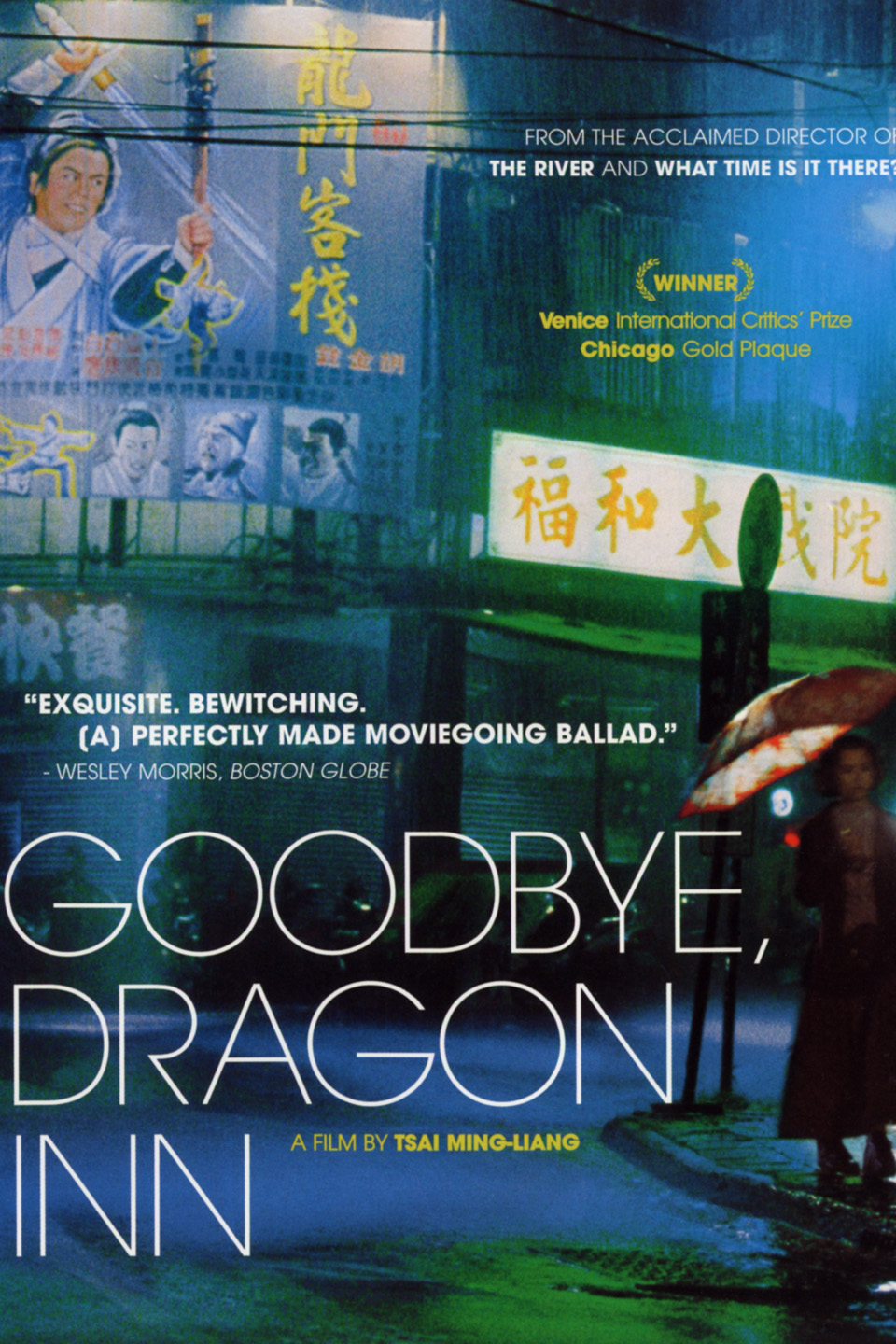
Goodbye Dragon Inn - (Dir. Tsai Ming-Liang, 2003)


(Reviewed 5/5 on letterboxd in Oct 2016)

"No one goes to the movies any more", remarks one of the members of the audience to another towards the end of the film. They happen to be only two of the three who sat through the entire film (King Hu's Dragon Inn); the third being a child. There is also a good reason why they sat through it which I will not reveal. Tsai clearly seems to wax nostalgic about the ritual of watching films at single screen theatre's. It was something more than just spending some of the extra bucks that yuppies make today.
"The theatre is haunted", says one of the many men smoking around the deserted premises of the theatre. You never figure out which of these might be ghosts but clearly the theatre has its own spirit as we see the characters roaming around the semi lit corridors. The rickety sounds of their footsteps, the distant echos of the movie playing on the screen, the incessant rain, the loneliness; all seem to add to the haunting personality of this decrepit yet majestic theatre. As with so many Tsai movies, there is a Tatiesque "lame" and "gay" joke running through the entire length of the film and finally you are also left with the possibility of a deeply affecting story of unrequited love between two of the characters who run this theatre. Clearly, Tsai loves to titillate us with possibilities both on and off screen that make his films so magical.
Finally, if you are one of those critical of the long shot aesthetic, you absolutely must watch this film. It has perhaps the greatest compilation of static long shots I have ever seen. All in all, this is clearly one of those films with the imprint of a genius at work.

Saturday, July 30, 2016

The Man Who Shot Liberty Valance (Dir. John Ford, 1962)


(Reviewed 4.5/5 on letterboxd in July 2016)

"Cold blooded murder, but I can live with it" - Tom Doniphon
This is perhaps Ford's most nuanced western chronicling the history of America. According to Ford, civilization was not only won by principled educated non violent men. There were also the gun totting ranchers and cowhands, some of whom willingly or unwillingly went into oblivion but not without playing important if controversial roles of defeating the Liberty Valance's of the land. As usual, Ford shines the brightest in the most unassuming scenes; whether it is the drunk newspaperman breaking into a monologue in his office or the village belle picking up books from the floor and contemplating after an interrupted school session. Ford just keeps getting better on every re-watch.

Sunday, July 17, 2016

La Commune (Dir. Peter Watkins, 2000)


(Reviewed 5/5 on letterboxd in July 2016)

Too many great and relevant points made in this movie, not only in its subject matter but also in the revolutionary style of filmmaking -whether it be women's rights or exposing the lie that is the media or an unexpectedly great Gandhi quote on "not building walls" (I am speaking to you Mr. Trump) or the fact that every actor had an opinion and was allowed to express it.
What was most heartening and perhaps the most important takeaway from the film is the search for the real meaning of democracy. Democracy is not only about voting for a representative but it is also about taking individual responsibility for everything that happens under it whether good or bad. A dialogue towards the end of the movie between the aggressor military man and a Commune woman summarizes this beautifully:

 - "What is your name?"
 - "LA COMMUNE"

 - "What did you do in the Commune?"
 - "EVERYTHING!"